There’s a shift happening in how your potential clients find a mortgage broker – and most brokers haven’t noticed yet.
A 2026 study by SEO agency Eight Oh Two found that 37% of consumers now begin their searches with AI tools rather than traditional search engines (Eight Oh Two, 2026). When someone asks ChatGPT “who’s a good mortgage broker in London?” or “what should I look for when refinancing in 2026?” – it’s pulling those answers from somewhere. And increasingly, that somewhere is LinkedIn.
Two independent research studies published in early 2026 confirm that LinkedIn has become one of the most cited platforms across AI tools including ChatGPT, Google AI Mode, Perplexity, Microsoft Copilot, and Gemini. For mortgage brokers who publish regularly on LinkedIn and send newsletters, this changes the game entirely. Your content isn’t just for followers anymore. It’s training material for the AI tools your next clients are already using.
This guide breaks down what the research actually means for mortgage professionals, and exactly how to structure your LinkedIn posts, articles, and newsletters so that AI tools cite you – not your competition.
Key Takeaways
- LinkedIn is now the #2 most-cited source in AI search overall, and the #1 source for professional queries (SEMrush, 2026)
- Long-form articles, newsletters, and posts account for 60% of all LinkedIn AI citations (LinkedIn, 2026)
- 95% of cited LinkedIn content is original posts – not reshares (SEMrush, 2026)
- The optimal article length for AI citation is 800-1,200 words, with posts performing best at 200-300 words
- Mortgage brokers who write educational, structured, expert-led content now have a clear window to build AI visibility before the space gets crowded
Why Is LinkedIn Suddenly So Important for AI Search?
LinkedIn’s rise in AI search has been one of the fastest domain-authority shifts recorded in 2026. According to data tracking platform Profound, which analysed citation patterns across six major AI platforms from November 2025 to February 2026, LinkedIn wasn’t even in the top 20 cited domains at the start of that period (Profound, 2026). By February, it had climbed to fifth overall – and to the top spot specifically for professional queries.
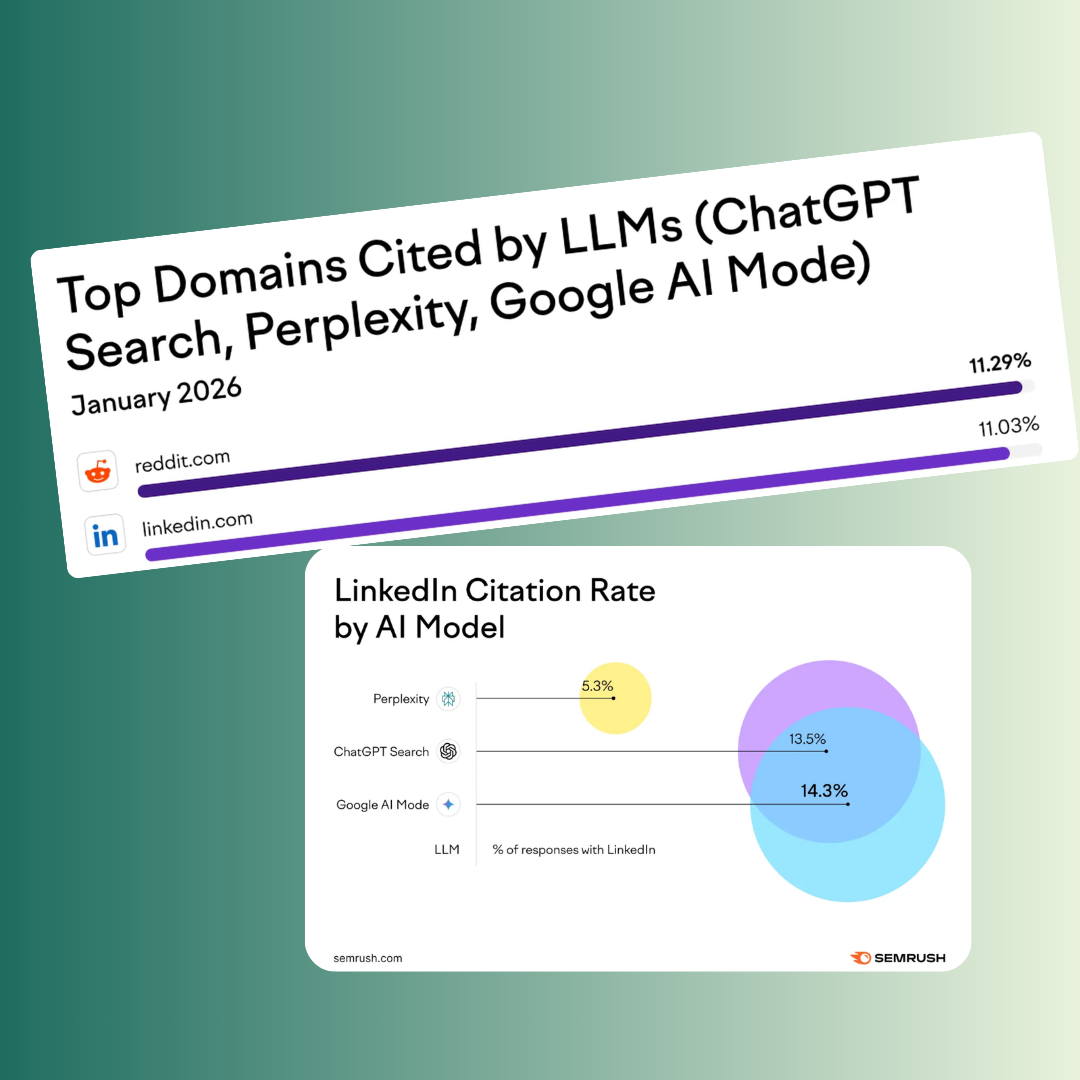
SEMrush confirmed this in a separate study examining 325,000 unique prompts across ChatGPT Search, Google AI Mode, and Perplexity (SEMrush, 2026). LinkedIn ranked second overall, just behind Reddit, and first for professional and business categories – which includes finance, property, and lending.
Why did this happen so fast? A few reasons:
- Expert authorship. LinkedIn’s user base is professionals sharing real experience. AI models are increasingly trained to value authentic, first-hand knowledge over generic aggregated content – and LinkedIn is one of the few platforms where that exists at scale.
- Microsoft integration. LinkedIn is owned by Microsoft, which also owns Copilot and has deep integrations with OpenAI. That relationship almost certainly accelerates how LinkedIn content gets indexed and weighted.
- Engagement signals. LinkedIn’s like, comment, and reaction systems give AI crawlers quality signals that help distinguish useful content from noise. According to LinkedIn’s own guidance, posts with 10 or more comments show improved AI discovery (LinkedIn , 2026).
There’s a direct parallel to the mortgage industry here. Borrowers searching for mortgage advice via AI tools are asking questions that require genuine expertise – not generic search results. LinkedIn is the one platform where mortgage brokers already have permission to speak with authority.
For mortgage brokers, this matters for a very specific reason: the questions borrowers ask AI tools are exactly the questions brokers answer every day. “How much can I borrow on a 30k salary?” “Is now a good time to fix my rate?” “What’s the difference between a comparison rate and an interest rate?” These aren’t questions AI tools can answer with a Wikipedia article. They pull from expert voices – and right now, most brokers aren’t positioning themselves as one.
Check out our blog on how to create an effective social media strategy
What Type of LinkedIn Content Gets Cited by AI?
Not all LinkedIn content performs equally in AI search. The research points clearly to format, length, and originality as the three biggest levers.
- Format matters enormously. Profound’s longitudinal data found that the share of LinkedIn citations coming from feed posts and long-form articles grew from 26.9% in November 2025 to 34.9% by February 2026 – an 8 percentage point increase in just three months (Profound, 2026). Over the same period, citations to profile pages dropped sharply, from 33.9% to just 14.5%. AI tools are increasingly moving toward citing what brokers create, not just who they are.
- Length has a sweet spot. For articles, Profound’s data shows the most-cited range sits between 500 and 2,000 words. LinkedIn’s own testing suggests 800–1,200 words performs particularly well for articles with enough depth to answer a detailed question (LinkedIn, 2026). For feed posts, SEMrush found 200–300 words is enough to deliver a useful takeaway and spark conversation.
- Originality is non-negotiable. SEMrush’s analysis of 89,000 cited LinkedIn URLs found that 95% of all citations go to original posts – not reshares or reposts (SEMrush, 2026). Sharing someone else’s article with a line of commentary won’t cut it. The content needs to come from you, in your own words, based on your own experience.
Here’s what this looks like in practice for a mortgage broker:
| Content Type | Ideal Length | AI Citation Potential |
|---|---|---|
| LinkedIn Article / Newsletter | 800–1,200 words | High |
| Feed post (educational) | 200–300 words | Medium–High |
| Feed post (update/reshare) | Any | Very low |
| Profile page | N/A | Declining |
Mortgage brokers are in a stronger position than most professionals to capitalise on this. Financial services and professional queries are the exact categories where LinkedIn performs best in AI search. The competition for AI citations in mortgage is, right now, extremely thin.
How Should Mortgage Brokers Structure Their Posts for AI?
Structure is one of the clearest signals AI tools use to evaluate content. A well-structured post is one a language model can parse, segment, and extract a direct answer from. A wall of text, even a smart one, is harder to cite.
LinkedIn’s own published guidance recommends the journalistic “inverted pyramid” approach: lead with your most important information first, then support it with evidence and context in descending order of relevance (LinkedIn, 2026). For mortgage brokers, this means your post should open with the answer, not the windup.
LinkedIn also recommends using formats like ranked lists and clear steps, which give AI models structured segments they can lift directly (LinkedIn, 2026). For newsletters, this means using subheadings for each section, keeping paragraphs short, and framing each section around a specific question your client base actually asks.
Additional structural tips from the research:
-
- Include specific dates. A post titled “The best fixed rates available in March 2026” tells AI tools the content is current. Freshness signals matter – Profound’s data showed LinkedIn’s citation trajectory accelerated partly because answer engines weight recently published content for time-sensitive queries (Profound, 2026).
- Include specific dates. A post titled “The best fixed rates available in March 2026” tells AI tools the content is current. Freshness signals matter – Profound’s data showed LinkedIn’s citation trajectory accelerated partly because answer engines weight recently published content for time-sensitive queries (Profound, 2026).
-
- Use a “Question: Answer” format. LinkedIn’s internal data shows posts framed this way perform well – and the post URL is often generated from the opening line, reinforcing the question as a citation target.
- Use a “Question: Answer” format. LinkedIn’s internal data shows posts framed this way perform well – and the post URL is often generated from the opening line, reinforcing the question as a citation target.
-
- Keep your opening line punchy. The first sentence of a post is often what gets cited. Make it a clear, standalone claim.
According to research from SEMrush, the median cited LinkedIn post has just 15–25 reactions and no more than one comment (SEMrush, 2026). AI retrieval isn’t a popularity contest. A niche post answering a specific mortgage question will outperform a broadly liked motivational post every time.
Read our article on LinkedIn content framework
What Topics Should Mortgage Brokers Write About?
The topics that perform best in AI search are the ones that match real questions borrowers type into chatbots. Think about the questions you get asked in every initial client call – those are your content brief.
Here are proven topic categories, mapped to the AI citation opportunity:
1. Explainers on mortgage concepts Posts that define and explain specific terms perform strongly because they answer clear definitional queries. Examples: “What is LTV and why does it matter?”, “Fixed vs variable in 2026”
2. Step-by-step process guides Anything that walks a borrower through a process is highly citable. “How to get pre-approval as a self-employed borrower,” “The 6-step process we use to find the right lender for each client.”
3. Timely market commentary with a specific angle General “market update” posts get ignored. Specific ones don’t. “Why I’m recommending clients hold off fixing their rate until the Bank of England announcement” is far more citable than “rates are moving – interesting times ahead.”
4. Myth-busting content “Three things your bank won’t tell you about refinancing” – this format answers the implicit question “is my bank giving me the best deal?” It’s exactly the kind of question someone asks an AI chatbot.
5. Case studies (anonymised) “Client scenario: how we helped a self-employed couple borrow £425k with two years of tax returns” signals real expertise. AI tools value specificity and first-hand experience.
One pattern that consistently performs: translating a single client question from that week into a short LinkedIn post. If a borrower asked you something that surprised you, there are probably thousands of people typing the same question into ChatGPT right now.
LinkedIn also noted that actionable, educational content substantially outperforms opinion pieces and personal updates in AI citation frequency (LinkedIn, 2026). This doesn’t mean you can’t be personal – but the personal needs to be in service of something genuinely useful to the reader.
How Do Newsletters Fit Into This Strategy?
LinkedIn newsletters are one of the most underused tools in a mortgage broker’s content toolkit- and they happen to be among the formats AI tools cite most often. Along with long-form articles, newsletters are specifically highlighted in the research as a top citation source, contributing to the 60% of AI citations that come from long-form, published LinkedIn content (LinkedIn, 2026).
The key advantage of a newsletter is that it trains both your audience and AI tools to expect regular, substantive expertise from you. Frequency matters for freshness signals. If you publish a 900-word newsletter on mortgage market conditions every two weeks, you’re giving AI crawlers fresh, topical, professional content on a predictable schedule. Over time, this compounds.
For newsletters specifically, the structure guidance above applies even more strongly. A well-organised newsletter with a clear heading hierarchy, short paragraphs, and each section addressing a specific question will be far more extractable than a long narrative. Think about it from the AI’s perspective: it’s looking for a passage it can quote as a direct answer to “what’s happening with mortgage rates right now?” Your newsletter needs to have a section that reads like exactly that.
A simple newsletter structure that aligns with AI citation best practices:
- Opening: one key insight from the week (2–3 sentences, direct claim up front)
- Market update: rates, lender changes (use dates, use numbers)
- Client scenario or case study (specific, anonymised, educational)
- One actionable tip (structured as a list or numbered steps)
- Closing question or CTA (invites replies and engagement)
Keep each section tight. 150-200 words per section is plenty. The goal is depth of insight, not length of prose.
Does Being Authentic Actually Matter for AI Visibility?
Yes – and LinkedIn’s guidance on this point is unusually direct. Publishing authentic content, rather than fully AI-generated text, can help avoid being flagged or blocked from AI indexing (LinkedIn, 2026).
This is worth sitting with for a moment. If you use AI to write your LinkedIn posts wholesale, you may be training AI to ignore you. The entire premise of LinkedIn’s growing authority in AI search is that its content represents real human expertise. When that signal degrades – when the platform fills up with generic, AI-generated content – the citation advantage degrades too.
For mortgage brokers, this is actually good news. You have something AI can’t generate: 10 years of client calls, lender relationships, deals that fell over and deals that came together unexpectedly. That experience, put into direct, specific, structured language, is exactly what AI tools are looking for.
The SEMrush research reinforces this with a striking finding: AI responses to LinkedIn content have semantic similarity scores between 0.57 and 0.60 – significantly higher than for Reddit (0.53–0.54) or Quora (0.435) (SEMrush, 2026). This means AI tools don’t just cite LinkedIn – they echo it. When you publish well-structured content on LinkedIn, the AI’s answer to a borrower’s question is likely to closely mirror what you actually wrote. Your message, your framing, your expertise – surfaced to a potential client before they’ve ever visited your website.
The opportunity is now, and it won’t stay this uncrowded for long.
Most mortgage brokers aren’t thinking about LinkedIn as an AI discovery tool yet. The brokers who start structuring their content this way in the next 90 days will build a compounding advantage as answer engines continue to treat LinkedIn as a primary source.
If you’d like help auditing your current LinkedIn presence for AI visibility, or building a content calendar tailored to your broker niche, get in touch via the contact us form
Conclusion
The shift to AI-led discovery isn’t coming – it’s already here. And LinkedIn has become the most important professional content platform in that new ecosystem, ranking as the leading cited source for professional queries across every major AI tool (Profound, 2026).
For mortgage brokers, the strategic opportunity is unusually clear:
-
- Write educational, expert-led content on LinkedIn – posts, articles, and newsletters
-
- Structure every piece with the answer first, clear headings, specific numbers, and recent dates
-
- Be the one who explains mortgage concepts that borrowers are already typing into ChatGPT
-
- Publish consistently, in your own voice, with genuine experience behind the words
The brokers who get this right now will find that AI tools don’t just refer to them- they echo them. Your expertise, your framing, your answers, surfaced to potential clients before they’ve ever heard your name.
That’s a distribution channel no ad spend can replicate.
FAQ
Questions You Probably Have
Does LinkedIn content actually show up in ChatGPT answers?
Yes. According to a Profound analysis of 1.4 million citations, LinkedIn’s citation frequency on ChatGPT more than doubled between November 2025 and February 2026, and ChatGPT Search now references LinkedIn in 14.3% of responses (Profound, 2026). Professional and financial services queries are among the categories where LinkedIn performs strongest.
How long should a mortgage broker's LinkedIn article be for AI visibility?
The most-cited LinkedIn articles sit in the 500–2,000 word range, with LinkedIn’s own testing suggesting 800–1,200 words as the sweet spot for depth and readability (LinkedIn, 2026). For feed posts, 200–300 words is sufficient to generate a strong, citable takeaway.
Do I need a large following for my LinkedIn posts to be cited by AI tools?
No. SEMrush’s analysis found the median cited LinkedIn post has just 15-25 reactions and no more than one comment (SEMrush, 2026). AI citation is driven by relevance, not popularity. A niche, well-structured post answering a specific borrower question will outperform a widely-liked generic one.
Is it better to post as an individual or from a company page?
Both contribute, but differently. Perplexity tends to cite company pages most often (59%), while ChatGPT Search and Google AI Mode more frequently cite individual creators (59%) (SEMrush, 2026). A mixed strategy – personal posts supported and amplified by a company page – provides the broadest AI citation coverage.
Will AI-generated content hurt my LinkedIn visibility?
LinkedIn has indicated that publishing fully AI-generated text can result in content being flagged or blocked from AI indexing (LinkedIn, 2026). Using AI as a drafting or editing tool is fine – but content should reflect your genuine expertise, voice, and first-hand experience to perform well in AI search.